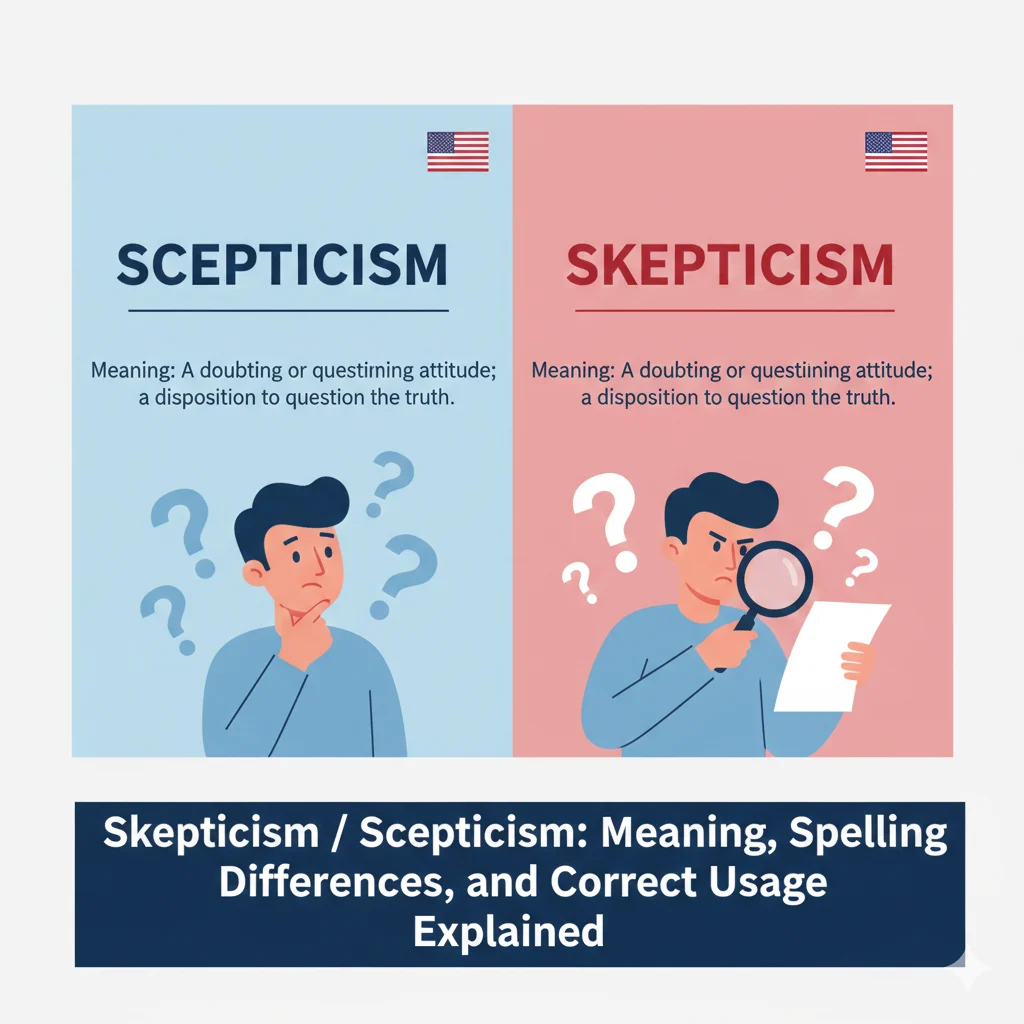
Skepticism or scepticism means doubting or questioning a claim instead of accepting it immediately. A skeptical person asks for proof. A sceptical person does the same. The difference is spelling, not meaning.
For example, if someone promises instant success, skepticism helps you pause and ask questions. In daily life, skepticism protects you from false news, scams, and exaggeration. In philosophy, skepticism is a theory that questions what humans can truly know.
Many people search “scepticism or skepticism meaning” because both spellings appear online. Others ask “Is skepticism or scepticism correct?” The simple answer is: both are correct. Usage depends on location and audience.
The Origin of Skepticism or Scepticism
The word comes from the ancient Greek word skeptikos, meaning “to examine” or “to consider carefully.” Greek skeptics believed that humans should question beliefs and avoid blind certainty.

The term entered Latin as scepticus and later moved into English. Early English favored the “sc” spelling, which gave us scepticism and sceptic. Over time, American English simplified spellings. This change produced skepticism and skeptic.
That history explains why people ask “Are ‘skeptic’ and ‘sceptic’ the same?” Yes, they are the same word with different spellings. The meaning never changed, only the letters.
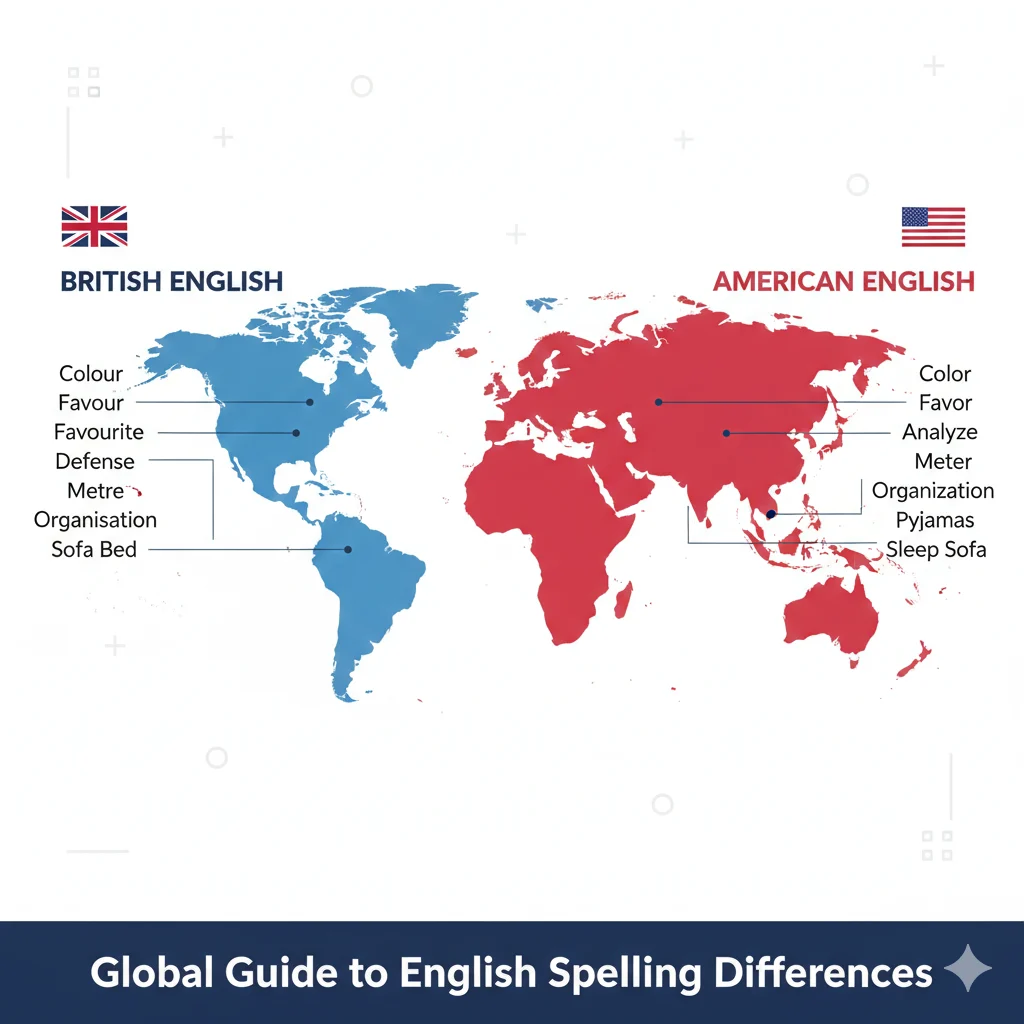
Spelling differences exist because English developed differently in Britain and America. Noah Webster promoted simpler spellings in the United States. His influence shaped modern American English.
British English vs American English Spelling
The main difference between skepticism and scepticism is regional spelling. British English keeps older spellings. American English prefers simplified forms.
| Aspect | British English | American English |
|---|---|---|
| Noun | scepticism | skepticism |
| Adjective | sceptical | skeptical |
| Person | sceptic | skeptic |
| Usage region | UK, Australia, India | United States |
| Meaning | Doubt or questioning | Doubt or questioning |
People often ask “Is ‘sceptical’ British English?” Yes. That spelling is standard in the UK and Commonwealth countries.
Pronunciation is the same. Searches for “skepticism or scepticism pronunciation” show that spelling does not change how the word sounds.

Waving / Waiving – What’s the Difference and Which One Is Correct?
Which Spelling Should You Use?
Choose the spelling based on your audience.
If you write for the United States, use skepticism. American readers expect this form. It looks natural in US blogs, news, and academic writing.
If you write for the UK, Australia, or Commonwealth countries, use scepticism. That spelling matches British English rules.
If your audience is global, consistency matters most. Pick one spelling and use it throughout. Many international brands choose American spelling for simplicity.
For SEO, using both spellings once can help answer user intent. That is why guides often include both versions clearly.
Common Mistakes with Skepticism or Scepticism
Many errors happen with this word. Here are the most common ones.
One mistake is mixing spellings in one article. Do not switch between skepticism and scepticism randomly.
Another error is confusing skepticism with negativity. Skepticism is thoughtful doubt, not automatic disbelief.
Some writers misuse it as an insult. Skepticism is not rudeness. It is careful thinking.
People also confuse scepticism vs cynicism. Cynicism assumes bad intent. Skepticism only asks for evidence.
Correct usage improves clarity and trust in writing.
Skepticism or Scepticism in Everyday Examples
Here are clear skepticism examples from daily life.
Email:
“I read the proposal with skepticism and asked for more data.”
News:
“Scientists expressed skepticism about the early results.”
Social media:
“I remain skeptical until facts are shared.”
Formal writing:
“Philosophical skepticism challenges assumptions about knowledge.”
These examples show how the word fits both casual and formal contexts.
Skepticism or Scepticism in Philosophy
Skepticism philosophy is a major branch of thought. It questions whether true knowledge is possible.
Ancient philosophers like Pyrrho argued that humans should suspend judgment. Modern philosophers explore skepticism theory in science, ethics, and perception.
For example, how do we know reality is real? How do we trust our senses? These questions form the base of philosophical skepticism.
Students often search “skepticism PDF” to study academic theories. In education, skepticism is not denial. It is a tool for learning.
Skepticism or Scepticism – Google Trends & Usage Data
Search data shows that skepticism dominates in the United States. Scepticism is more popular in the UK, India, Australia, and Pakistan.
Academic searches favor both spellings depending on journal style. News outlets follow regional language rules.
Google Trends reveals that interest increases during elections, health debates, and scientific discoveries. People seek reliable information and question claims.
This shows that skepticism plays a key role in modern digital life.
Comparison Table: Keyword Variations
| Variation | Meaning | Region |
|---|---|---|
| Skepticism | Doubt with reason | USA |
| Scepticism | Doubt with reason | UK |
| Skeptical | Questioning | USA |
| Sceptical | Questioning | UK |
| Skeptic | Questioner | USA |
| Sceptic | Questioner | UK |
FAQs About Skepticism or Scepticism
What is the meaning of skepticism?
It means questioning claims instead of believing them without proof.
Is skepticism or scepticism correct?
Both are correct. It depends on regional spelling.
Are “skeptic” and “sceptic” the same?
Yes. The meaning is identical.
Is skepticism negative?
No. It supports critical thinking.
What are scepticism synonyms?
Doubt, inquiry, questioning, disbelief.
What is scepticism vs cynicism?
Skepticism asks questions. Cynicism assumes bad motives.
How is skepticism used in philosophy?
It questions knowledge, truth, and certainty.
Conclusion
Skepticism / scepticism is not about rejecting ideas. It is about thinking carefully before accepting them. The spelling difference confuses many people, but the meaning stays the same.
Use skepticism for American audiences. Use scepticism for British or Commonwealth readers. Stay consistent in your writing.
Understanding this word helps in academics, journalism, and daily communication. It improves clarity and protects against misinformation. In philosophy, skepticism encourages deeper thinking and honest inquiry.
Whether you are writing an email, a research paper, or a blog post, correct usage builds credibility. Remember that skepticism is healthy when balanced with open-mindedness.
Mastering this small spelling difference can make your writing clearer, more professional, and more trusted.