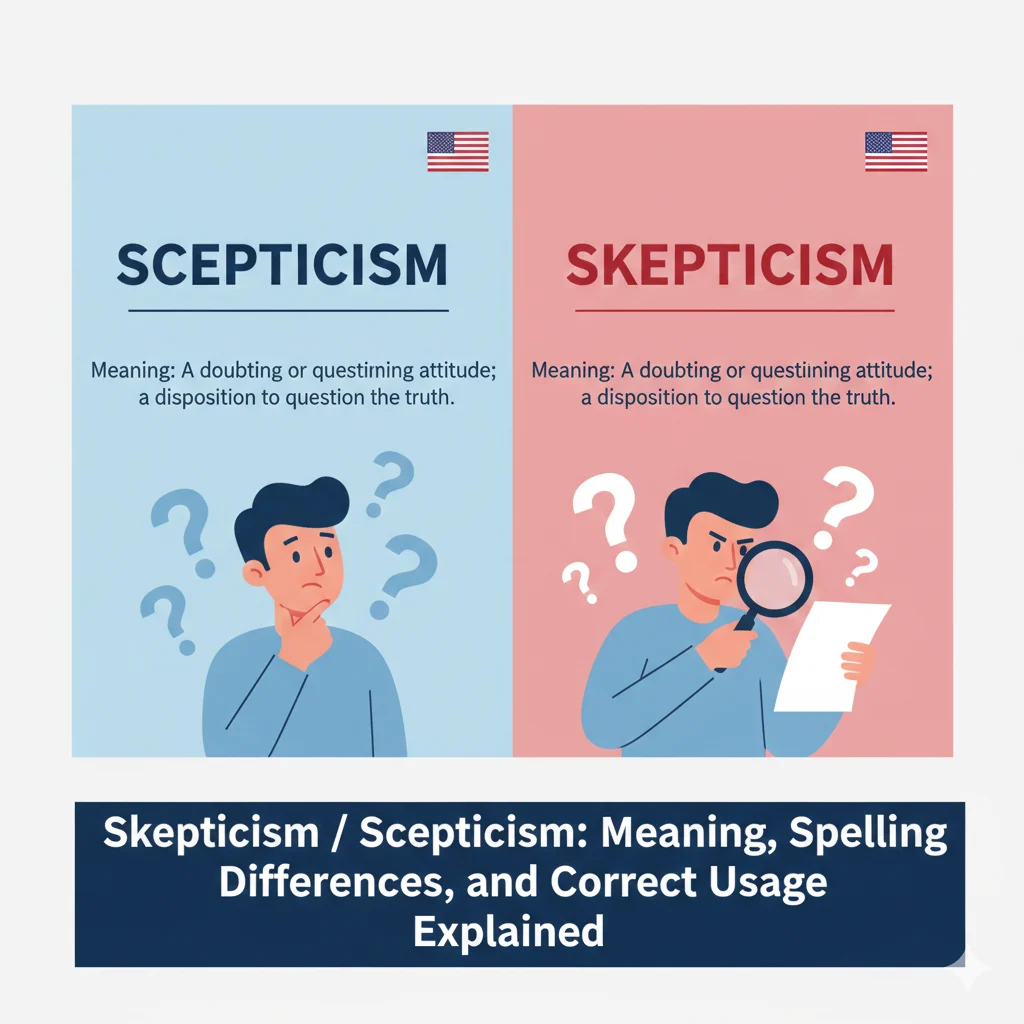
Confused between “skepticism” and “scepticism”? Many students and writers struggle with the spelling difference between American and British English, which can make their writing look inconsistent or incorrect. Knowing which version to use is important for clarity, professionalism, and credibility.
In simple terms, “skepticism” is the American English spelling, while “scepticism” is the British English spelling. Both words mean the same thing: a questioning or doubting attitude toward statements, beliefs, or claims.
This guide explains the difference between skepticism and scepticism, shows examples in sentences, and provides tips to remember the correct usage. By understanding this distinction, you can write confidently, avoid mistakes, and make your English precise and professional.
📚 Philosophical Skepticism – A Complete Beginner’s Guide
Philosophical skepticism is one of the oldest and most important traditions in Western thought. It doesn’t claim that knowledge is impossible—it asks how we know what we claim to know.
Origins of Philosophical Skepticism:
| Period | Key Figures | Core Idea |
|---|---|---|
| Ancient Greece | Pyrrho, Sextus Empiricus | Suspend judgment; tranquility follows |
| Renaissance | Montaigne | “What do I know?” – Humble questioning |
| Early Modern | Descartes | Doubt everything to find certainty |
| Modern | Hume, Kant | Knowledge has limits we must respect |
Types of Philosophical Skepticism:
- Academic Skepticism – Knowledge is impossible; we can only have opinions.
- Pyrrhonian Skepticism – We should suspend all judgment and keep seeking.
- Cartesian Skepticism – Methodological doubt to find indubitable foundations.
- External World Skepticism – Can we prove the external world exists?
- Skepticism About Other Minds – How do we know others have consciousness?
Famous Thought Experiments:
The Brain in a Vat: What if your brain is removed, kept alive in a lab, and fed electrical signals identical to real experiences? Could you prove otherwise?
Descartes’ Demon: What if an evil demon deceives you about everything—including mathematics? What remains certain?
The Matrix: Popular culture’s version of ancient skeptical questions.
Why Philosophical Skepticism Matters:
| It Teaches Us… | It Prevents… |
|---|---|
| Intellectual humility | Dogmatic certainty |
| Critical examination | Blind acceptance |
| Careful reasoning | Rash conclusions |
| Open-minded inquiry | Closed-mindedness |
Quotes on Philosophical Skepticism:
“All I know is that I know nothing.” – Socrates (attributed)
“I think, therefore I am.” – Descartes (his answer to skepticism)
“The skeptic does not deny the appearances, but questions the explanations.” – Sextus Empiricus
Skepticism in Daily Life:
You don’t need to be a philosopher to benefit from skeptical thinking:
- Question news headlines before sharing
- Ask for evidence before believing health claims
- Consider multiple perspectives on controversial issues
- Remain open to changing your mind
Philosophical skepticism isn’t about perpetual doubt—it’s about thinking clearly before claiming to know.
The Origin of Skepticism or Scepticism
The word comes from the ancient Greek word skeptikos, meaning “to examine” or “to consider carefully.” Greek skeptics believed that humans should question beliefs and avoid blind certainty.

The term entered Latin as scepticus and later moved into English. Early English favored the “sc” spelling, which gave us scepticism and sceptic. Over time, American English simplified spellings. This change produced skepticism and skeptic.
That history explains why people ask “Are ‘skeptic’ and ‘sceptic’ the same?” Yes, they are the same word with different spellings. The meaning never changed, only the letters.
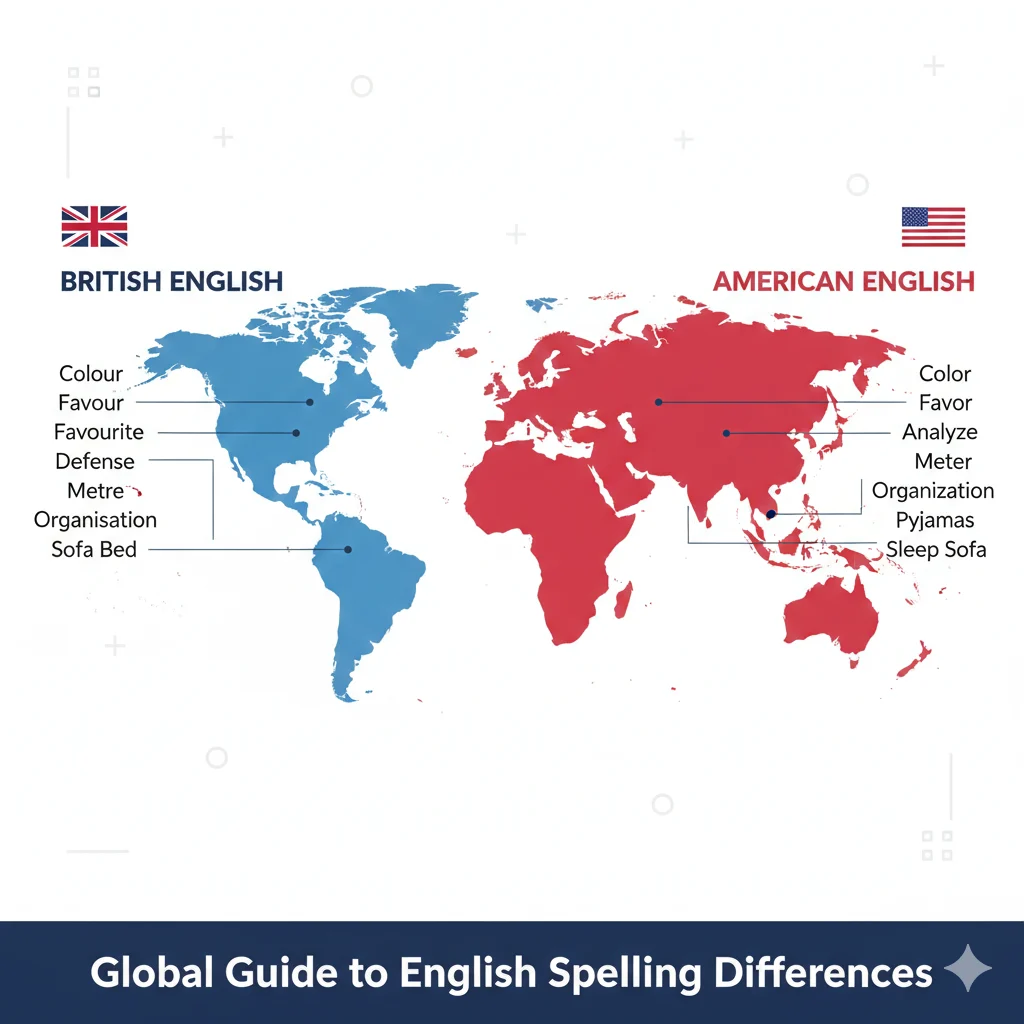
Spelling differences exist because English developed differently in Britain and America. Noah Webster promoted simpler spellings in the United States. His influence shaped modern American English.
British English vs American English Spelling
The main difference between skepticism and scepticism is regional spelling. British English keeps older spellings. American English prefers simplified forms.
| Aspect | British English | American English |
|---|---|---|
| Noun | scepticism | skepticism |
| Adjective | sceptical | skeptical |
| Person | sceptic | skeptic |
| Usage region | UK, Australia, India | United States |
| Meaning | Doubt or questioning | Doubt or questioning |
People often ask “Is ‘sceptical’ British English?” Yes. That spelling is standard in the UK and Commonwealth countries.
Pronunciation is the same. Searches for “skepticism or scepticism pronunciation” show that spelling does not change how the word sounds.

Waving / Waiving – What’s the Difference and Which One Is Correct?
Which Spelling Should You Use?
Choose the spelling based on your audience.
If you write for the United States, use skepticism. American readers expect this form. It looks natural in US blogs, news, and academic writing.
If you write for the UK, Australia, or Commonwealth countries, use scepticism. That spelling matches British English rules.
If your audience is global, consistency matters most. Pick one spelling and use it throughout. Many international brands choose American spelling for simplicity.
For SEO, using both spellings once can help answer user intent. That is why guides often include both versions clearly.
Common Mistakes with Skepticism or Scepticism
Many errors happen with this word. Here are the most common ones.
One mistake is mixing spellings in one article. Do not switch between skepticism and scepticism randomly.
Another error is confusing skepticism with negativity. Skepticism is thoughtful doubt, not automatic disbelief.
Some writers misuse it as an insult. Skepticism is not rudeness. It is careful thinking.
People also confuse scepticism vs cynicism. Cynicism assumes bad intent. Skepticism only asks for evidence.
Correct usage improves clarity and trust in writing.
🔍 Skepticism vs Cynicism – What’s the Real Difference?
Many people confuse skepticism with cynicism, but they are fundamentally different mindsets. Understanding this distinction improves both your writing and critical thinking.
Skepticism Defined:
- Asks questions – Skeptics want evidence before believing.
- Remains open – If proof appears, skeptics accept it.
- Seeks truth – The goal is accuracy, not disbelief.
- Healthy approach – Used in science, journalism, and philosophy.
Cynicism Defined:
- Assumes bad intent – Cynics believe people are selfish or dishonest.
- Closed to evidence – Even with proof, cynics doubt motives.
- Expects worst – Assumes negative outcomes automatically.
- Protective stance – Often stems from disappointment or hurt.
Quick Comparison Table:
| Aspect | Skepticism | Cynicism |
|---|---|---|
| Attitude | “Show me evidence” | “I don’t trust you anyway” |
| Openness | Open to proof | Closed, dismissive |
| Focus | Ideas and claims | People and motives |
| Outcome | Better understanding | Distrust and isolation |
| Example | “Does this study have reliable data?” | “They’re just saying that for money.” |
Examples in Sentences:
Skepticism: “The scientist viewed the results with healthy skepticism and requested more trials.”
Cynicism: “He dismissed the apology with cynicism, assuming it was just damage control.”
Why It Matters:
Skepticism builds knowledge. Cynicism builds walls. In writing, using the wrong word changes your meaning entirely. If you call someone skeptical when they are actually cynical, you misrepresent their character.
Remember: Skepticism questions claims. Cynicism questions motives.
Skepticism or Scepticism in Everyday Examples
Here are clear skepticism examples from daily life.
Email:
“I read the proposal with skepticism and asked for more data.”
News:
“Scientists expressed skepticism about the early results.”
Social media:
“I remain skeptical until facts are shared.”
Formal writing:
“Philosophical skepticism challenges assumptions about knowledge.”
These examples show how the word fits both casual and formal contexts.
🔬 Scientific Skepticism – The Engine of Discovery
Scientific skepticism is not about doubt for its own sake. It is a systematic approach to evaluating claims based on evidence. This principle drives all modern science and protects us from misinformation.
What Is Scientific Skepticism?
Scientific skepticism means:
- Questioning claims until evidence supports them
- Demanding reproducible results before accepting findings
- Remaining open to new evidence that challenges existing beliefs
- Applying critical thinking to all ideas, including popular ones
Why Science Needs Skepticism:
Without skepticism, false claims spread easily. History shows why this matters:
| Claim | Initial Belief | Skepticism Revealed |
|---|---|---|
| Bleeding cures illness | Accepted for centuries | Harmful, ineffective |
| Tobacco is healthy | Advertised by doctors | Causes cancer |
| Vaccines cause autism | Promoted by one study | Thoroughly debunked |
How Scientists Use Skepticism:
- Peer Review – Other experts examine research before publication
- Replication – Independent labs repeat experiments to verify results
- Falsification – Good theories can be proven wrong; bad ones cannot
- Ongoing Inquiry – Conclusions remain open to new evidence
Examples of Healthy Scientific Skepticism:
- “This study had only 20 participants. Let’s see if larger trials agree.”
- “The results are exciting, but we need independent verification.”
- “Before changing medical guidelines, we require multiple studies.”
Quotes About Scientific Skepticism:
“The first principle is that you must not fool yourself—and you are the easiest person to fool.” – Richard Feynman
“Extraordinary claims require extraordinary evidence.” – Carl Sagan
Scientific Skepticism vs Denial:
Important distinction:
- Skeptic – “Show me the evidence; I’ll follow where it leads.”
- Denier – “I reject the evidence because I dislike the conclusion.”
Scientific skepticism builds trust in reliable knowledge. It separates science from pseudoscience and protects society from harmful misinformation.
Skepticism or Scepticism in Philosophy
Skepticism philosophy is a major branch of thought. It questions whether true knowledge is possible.
Ancient philosophers like Pyrrho argued that humans should suspend judgment. Modern philosophers explore skepticism theory in science, ethics, and perception.
For example, how do we know reality is real? How do we trust our senses? These questions form the base of philosophical skepticism.
Students often search “skepticism PDF” to study academic theories. In education, skepticism is not denial. It is a tool for learning.
Skepticism or Scepticism – Google Trends & Usage Data
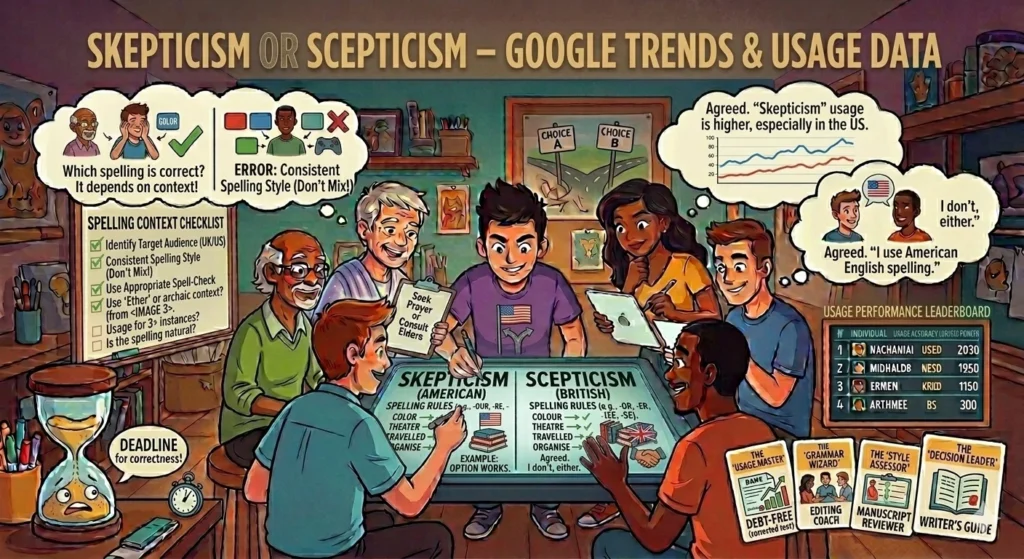
Search data shows that skepticism dominates in the United States. Scepticism is more popular in the UK, India, Australia, and Pakistan.
Academic searches favor both spellings depending on journal style. News outlets follow regional language rules.
Google Trends reveals that interest increases during elections, health debates, and scientific discoveries. People seek reliable information and question claims.
This shows that skepticism plays a key role in modern digital life.
🌍 Why Skepticism Matters in Modern Life – A Practical Guide
In an age of information overload, skepticism isn’t just useful—it’s essential. Here’s why developing healthy skepticism protects you and improves your life.
The Information Challenge:
| Problem | How Skepticism Helps |
|---|---|
| Misinformation spreads fast | You verify before sharing |
| Clickbait headlines deceive | You read beyond the title |
| Fake experts promote nonsense | You check credentials |
| Emotional manipulation | You ask for evidence |
| Confirmation bias | You seek opposing views |
Skepticism in the Digital Age:
Before Sharing Content, Ask:
- Who created this and why?
- What evidence supports the claim?
- What do other sources say?
- Is this too good (or bad) to be true?
- Am I reacting emotionally?
Skepticism and Mental Health:
Healthy skepticism protects your mind:
- Reduces anxiety about alarming but false news
- Builds confidence in your judgment
- Prevents manipulation by bad actors
- Encourages thoughtful rather than reactive responses
Skepticism in Relationships:
Skepticism isn’t distrust. It’s wisdom:
- Give trust but verify important claims
- Observe patterns over time
- Ask clarifying questions
- Balance openness with boundaries
Skepticism in Professional Life:
Employers value skeptical thinking:
- Questions assumptions before acting
- Spots flaws in plans early
- Makes evidence-based decisions
- Avoids costly mistakes
Skepticism Checklist for Daily Use:
✅ Heard a surprising claim? Check the source.
✅ Feeling strong emotion? Pause before acting.
✅ Everyone agrees? Look for missing perspectives.
✅ Expert says so? Verify their expertise.
✅ Seems perfect? Look for hidden costs.
The Golden Rule of Skepticism:
“Trust, but verify.” – Russian proverb, adopted by Ronald Reagan
Skepticism doesn’t mean believing nothing. It means believing wisely. In a world full of noise, healthy skepticism helps you find signal.
Comparison Table: Keyword Variations
| Variation | Meaning | Region |
|---|---|---|
| Skepticism | Doubt with reason | USA |
| Scepticism | Doubt with reason | UK |
| Skeptical | Questioning | USA |
| Sceptical | Questioning | UK |
| Skeptic | Questioner | USA |
| Sceptic | Questioner | UK |
FAQs About Skepticism or Scepticism
What is the meaning of skepticism?
It means questioning claims instead of believing them without proof.
Is skepticism or scepticism correct?
Both are correct. It depends on regional spelling.
Are “skeptic” and “sceptic” the same?
Yes. The meaning is identical.
Is skepticism negative?
No. It supports critical thinking.
What are scepticism synonyms?
Doubt, inquiry, questioning, disbelief.
What is scepticism vs cynicism?
Skepticism asks questions. Cynicism assumes bad motives.
How is skepticism used in philosophy?
It questions knowledge, truth, and certainty.
Conclusion
Skepticism / scepticism is not about rejecting ideas. It is about thinking carefully before accepting them. The spelling difference confuses many people, but the meaning stays the same.
Use skepticism for American audiences. Use scepticism for British or Commonwealth readers. Stay consistent in your writing.
Understanding this word helps in academics, journalism, and daily communication. It improves clarity and protects against misinformation. In philosophy, skepticism encourages deeper thinking and honest inquiry.
Whether you are writing an email, a research paper, or a blog post, correct usage builds credibility. Remember that skepticism is healthy when balanced with open-mindedness.
Mastering this small spelling difference can make your writing clearer, more professional, and more trusted.