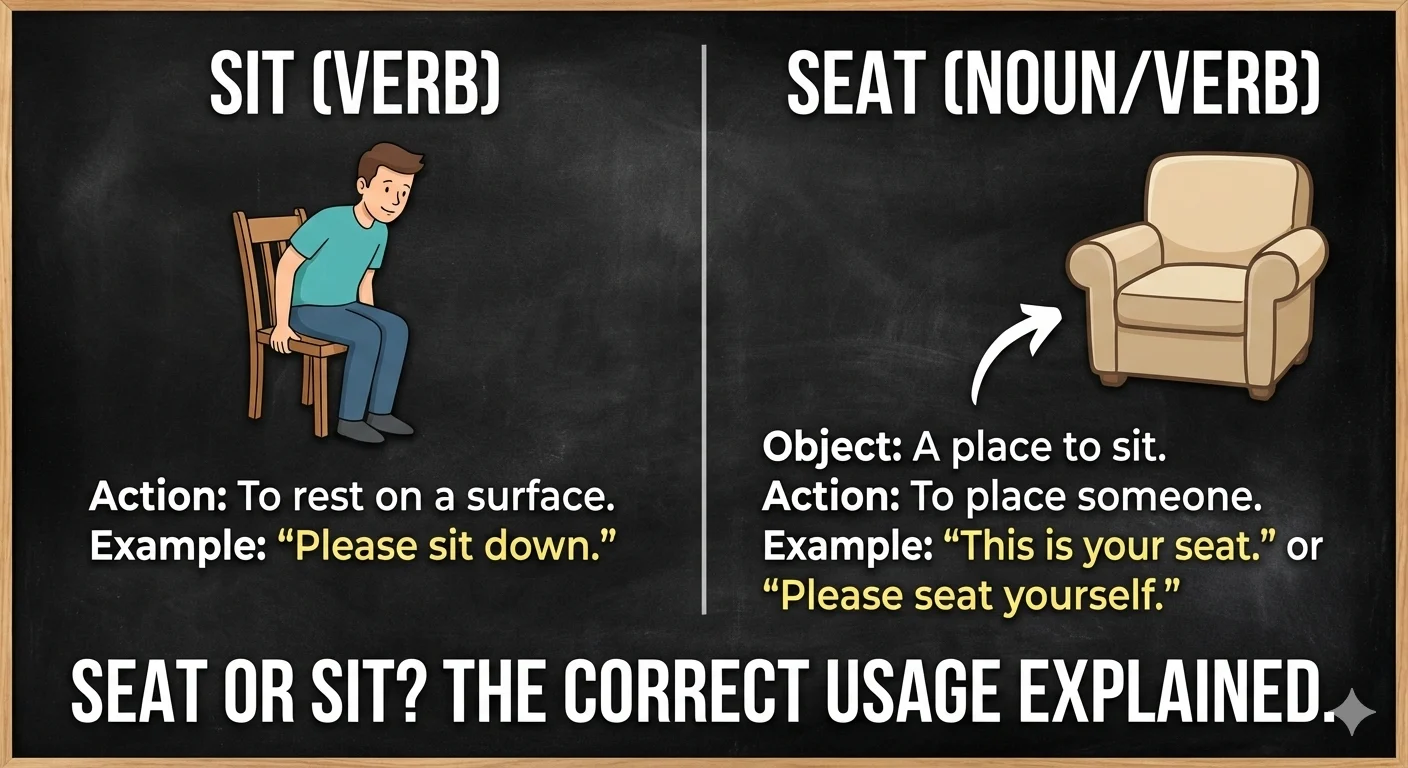
Many English learners and even native speakers get confused with seat and sit. Questions like “Is it my seat or my sit?”, “Can I have a sit or seat?”, or “Where do you seat or sit?” are very common. Using the wrong word can sound awkward or unprofessional.
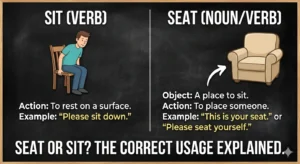
The rule is simple: seat = noun (a place to sit), sit = verb (the act of sitting). However, phrases like “have a sit or take a seat”, “take your seat or sit”, or “i want to seat or sit” can confuse learners.
In this guide, we explain seat or sit meaning, usage, pronunciation, examples, exam contexts, and the seat vs sit difference, including Hindi translation. By the end, you’ll confidently know when to say “window seat or sit”, “do not seat or sit”, or “can i seat or sit?”.
Seat or Sit Means
Seat = noun → a chair, bench, or spot.
Sit = verb → the act of resting on a seat.
Examples:
- Please take your seat. ✅
- Would you like to sit here? ✅
- Confusing: Can I have a sit or seat? ❌ → Correct: Can I have a seat?
Synonyms: chair, bench, stool, rest, perch, place, spot
Pronunciation:
- Seat → /siːt/
- Sit → /sɪt/
Pro Tip: Use seat for objects/places, sit for actions.
The Origin of Seat or Sit
- Sit → Old English sittan, meaning “to rest or be seated.”
- Seat → Old English setl, meaning “a place to sit.”
Over centuries, sit became the verb, and seat became the noun. That’s why you say:
- ✅ I will sit on the chair.
- ✅ Please take your seat.
British English vs American English

| Word | British English | American English | Example |
|---|---|---|---|
| Sit | Formal or casual | Casual | I will sit here. |
| Seat | Same in both | Same in both | Please take your seat. |
| Have a sit | Rarely used | Rarely used | ❌ Use have a seat |
| Take a seat | Formal | Common | ✅ Take a seat, please. |
Authority Tip: According to Oxford Dictionary, sit is always a verb, while seat is always a noun.
Indian English Context: In Indian exams, trains, and classrooms, seat or sit searches spike, especially during registration or exam season.
Which Spelling Should You Use?
- Sit → Actions: “Please sit down”, “Sit quietly during class”.
- Seat → Places: “Your seat is by the window”, “Seat or sit for exams”.
Audience Advice:
- US learners: “Sit” is casual, “seat” is formal.
- UK/Commonwealth learners: Slightly more formal in schools, offices, exams.
- Global English: Stick to the standard rule.
Mini-Tip: Use natural phrases like “take your seat or sit”, “have a seat or sit”, “window seat or sit”, and “let’s seat or sit”.
Common Mistakes with Seat or Sit
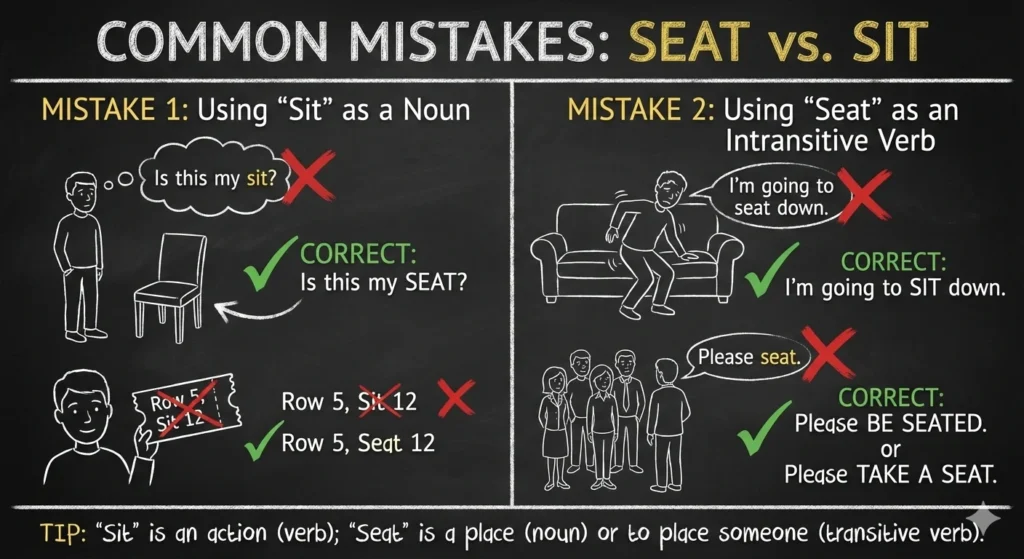
| Incorrect | Correct | Notes |
|---|---|---|
| I will seat here now | I will sit here now | Seat = place, sit = action |
| Can I have a sit? | Can I have a seat? | Sit = verb, cannot be object |
| Do not sit on seat | Do not sit on the seat | Must use article with noun |
| I want to seat down | I want to sit down | “Seat” rarely used as verb |
| You were not on seat or sit | You were not in your seat | Correct for classroom/exam |
Expert Tip: In exams, always use seat for positions.
Seat or Sit in Everyday Examples
Emails:
- Please take your seat before the meeting starts.
Social Media:
- Just grabbed my seat at the concert!
News Headlines:
- Passengers were asked to sit while the plane refueled.
Formal Writing:
- Kindly sit quietly during the lecture.
Exam Settings:
- Students must take their seat for the exam.
Other Natural Phrases:
- Take a seat or sit down.
- Window seat or sit preference.
- Where do you seat or sit in class?
- Can I seat or sit here?
- I want to seat or sit by the aisle.
- Do not seat or sit on the teacher’s desk.
- Let’s seat or sit together.
- I seat or sit near the window.
Seat vs Sit – Comparison Table
| Variation | Correct Usage | Example |
|---|---|---|
| Seat or sit | Sit (verb) / Seat (noun) | Take a seat, then sit quietly. |
| Is it my seat or my sit? | Seat | Is this my seat? |
| Can I have a sit or seat? | Seat | Can I have a seat? |
| Seat or sit for exams | Seat | Please take your seat for the exam. |
| Take your seat or sit | Seat / Sit | Take your seat and then sit comfortably. |
| Window seat or sit | Seat | I prefer the window seat. |
| I seat or sit | Sit | I will sit here. |
| Indian seat or sit | Seat / Sit | In Indian exams, take your seat and sit quietly. |
| Seat or sit difference | Explained | Seat = place, sit = action. |
| Let’s seat or sit | Sit / Seat | Let’s seat or sit together during the meeting. |
Seat or Sit – Google Trends & Usage
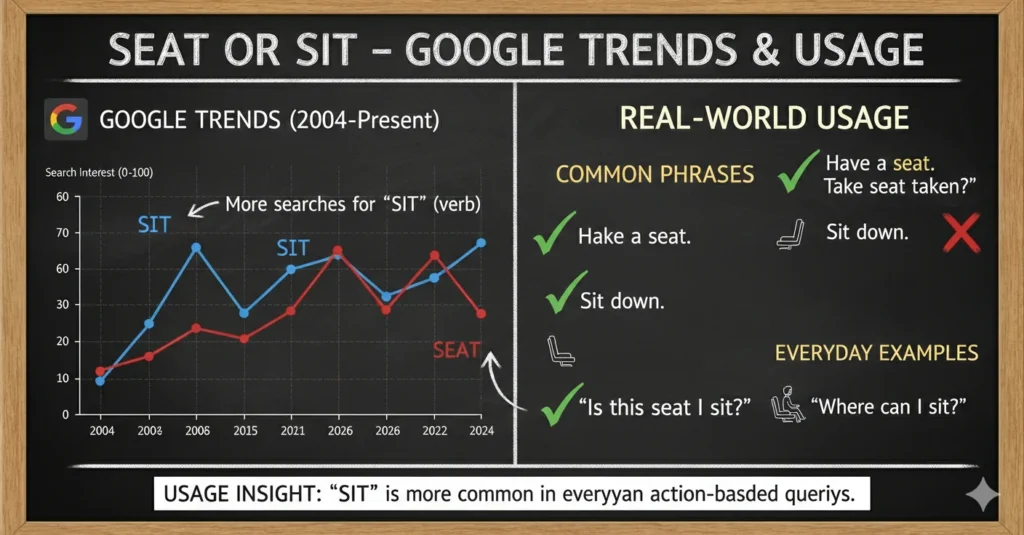
- Popular searches: seat or sit meaning, seat or sit for exams, take your seat or sit, can i seat or sit?, i want to seat or sit
- Peak usage: Exam season, airline bookings, classroom registrations
- Top countries: India, UK, US, Australia
- Related queries: Seat vs sit pronunciation, difference between sit and seat in Hindi, do not seat or sit
FAQs
1. Can I say “have a sit”?
No. Always use have a seat. Sit is a verb, not an object.
2. What is the difference between sit and seat in Hindi?
- Sit = बैठना
- Seat = सीट (जगह)
3. Where do you seat or sit?
You sit on a seat. Example: Sit on your seat by the window.
4. Can I use “seat” as a verb?
Yes, rarely: The usher seated the guests. Mostly use sit.
5. Which is correct: “window seat or sit”?
Correct: window seat. Example: I prefer the window seat.
6. Do I say “take a seat or sit”?
Yes, both are correct: Take a seat and then sit comfortably.
7. Is “you were not on seat or sit” correct?
Correct version: You were not in your seat.
8. Can I say “let’s seat or sit”?
Yes. Example: Let’s seat or sit together during the meeting.
Conclusion
Mastering seat or sit is easy once you remember: seat = noun, sit = verb. In classrooms, offices, airplanes, or exams, using the correct word improves clarity and professionalism. Always say “have a seat”, not “have a sit”, and use sit for actions like “sit quietly”.
Using phrases like “take your seat or sit”, “window seat or sit”, “seat or sit for exams”, “can i seat or sit?”, and “let’s seat or sit” ensures your English sounds natural, polite, and professional.
Pro Tip: Check your sentences: Practice using both words in real emails, exams, and social conversations to boost confidence and accuracy.

Neville Goddard was a visionary spiritual philosopher whose teachings on imagination and consciousness continue to transform lives. His work reveals how our thoughts create reality and how faith shapes destiny. On this angel number site, Neville’s perspective deepens our understanding of divine numbers — showing how each sequence mirrors our inner beliefs and the creative power of the mind.